

Founder Agreements – Part 2(with GPTs Assistant & Use case)

Yesterday’s post about founder agreements blew up more than I expected – comments, traffic to my Substack, even new subscribers.
Not surprising. I learned this lesson the hard way. So I decided to create a GPTs to help me systematically draft these boundaries in future.
TLDR:
Below is my story, essentials and example how I’d use it in future endeavors.
NB! This is not a legal advice. Please talk to your lawyer after you drafted something.
I once spent ten years building a company with a partner. Ten years of shared wins, shared failures, shared sleepless nights. And then it all blew up. Not because the market killed us, not because the product sucked – but because we couldn’t hold it together.
I wasn’t easy to work with. I didn’t know how to set boundaries, and I sure as hell didn’t respect his. When the stress spiked into the red zone, my ego chose to torch the whole thing instead of renegotiating like an adult. The formal reason? A side hustle plus burnout. The real reason? We were sick of each other.
The cost: ten years of friendship gone, one business dead, and millions left on the table.
That’s why I got very serious about founder agreements. Because here’s the thing: a founder agreement isn’t a legal checkbox. It’s a pre-marriage conversation. A stress test for the relationship before you hit turbulence.
So let’s get tactical. Here’s what needs to go in.
5 Non-Negotiables (skip these and you’re asking for drama)
Roles & Responsibilities
Who’s doing sales? Who’s doing marketing? Who’s writing the content? Who’s in charge of technology? How many hours per week is realistically expected from each founder?Equity Vesting + Commitment Cliff
Equity is earned, not gifted. Leave early, leave your shares. No drama, no lawsuits.IP & Audience Belong to the Company
Clients, social channels, domains, content – are these a company assets or personal toys?Exit & Buyout Formula
If someone leaves, the price and terms are already defined. No “we’ll figure it out later in court.”Deadlock Resolution
What happens if it’s 50/50 and you can’t agree? Pick an arbiter now (mentor, advisor), not later.
The Pre-Breakup Plan (without killing the vibe)
You can talk about ugly scenarios while everyone’s still smiling. That’s the trick.
Cooling-Off Exit (Founder Sabbatical)
Up to X weeks “time out” without stigma. But vesting pauses. If you don’t return – you’re out.Loss of Interest Clause
If someone’s done – either with this product or the company entirely – they get a clean buyout.Side Projects Rule
Got a new idea? Offer it to the company first. If rejected, you can build it separately – but not using the shared audience or client base.
Governance moves that make you investable at Series A
What investors want to see in your Data Room:
One clean legal entity with a transparent cap table and all IP assigned.
Advisory board in place – so when founders fight, decisions aren’t made by lawyers billing $800/hour.
Regular reviews – update the agreement every six months, don’t let it gather dust.
That sends the signal:
“These founders have their shit together. Internal fights won’t kill the company.”
⚡ How to Use GPTs Assistant for This
Here is the link to GPTs I created and use for this occasions:
Drafting this agreement doesn’t have to be brutal. Think of it as the difference between walking into battle naked vs. armored.
You can sit and talk to you co-founders over Zoom or Meet, click on “Dictate” button in your ChatGPT window, talk through it with your mates and send it to ChatGPT for transcription.
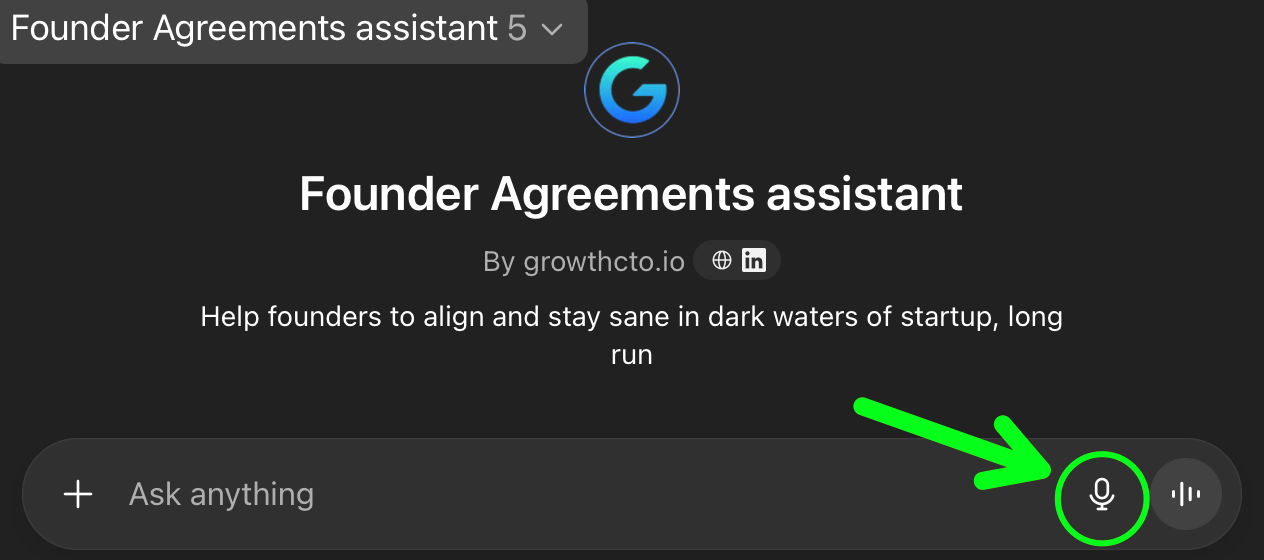
You can literally drop these clauses into a GPT-powered assistant and get a first draft customized to your team’s context. Then run it past a lawyer for final polish if you need to.
Example case
Scenario:
I considering launching a company which produces AI courses with a friend of mine. One founder runs marketing and funnels, the other produces creative and video. Due to my past experience, I have concerns that four months after, the creative partner burns out and needs a break.
The video:
Prompts
Prompt 1:
I want to start a business with a person I know for quite a long. He's actually a friend of mine. And I would like to start a business of AI course creation. He's a creative person and can be easily distracted to new ventures. And the primary idea is to... I'm going to handle the production and marketing part. He's going to handle the creation, content creation, curation, and all other things. And I would like to have a founder agreement drafted concerning the pain points I might experience with him, like multitasking across different households, and maybe get burned out because of no immediate result in this interesting business. And he's a cool guy, but I want to have some sort of fences here.
Prompt 2:
This is the thorough template. Another problem here is that he's working on his day job, and he's willing to quit as soon as this thing gonna start some traction. But I would like to interview him and discuss questions raised here, okay? So, the question is like, what if he gonna lose the interest in the project during the midway, or would like to switch to another product or project, especially if he would like to launch something independently, etc. So, let's extend.
Prompt 3:
Let's make a draft question script and make a list of topics to discuss with notes which we made here, like explanation of risk and mitigations. For example, questions and follow-up, which can disclose some risks or get more meat to think about.
Prompt 4:
Ok, what is left aside? Please combine and make a comprehensive canvas with all the interview questions and red flags above
Prompt 5:
Please review all the text above and think of what is left, what should be edited and we didn't ask yet. Please combine in the full message, don't be lazy, it's important.
Take care.
And Keep Building. Even when it feels pointless.