

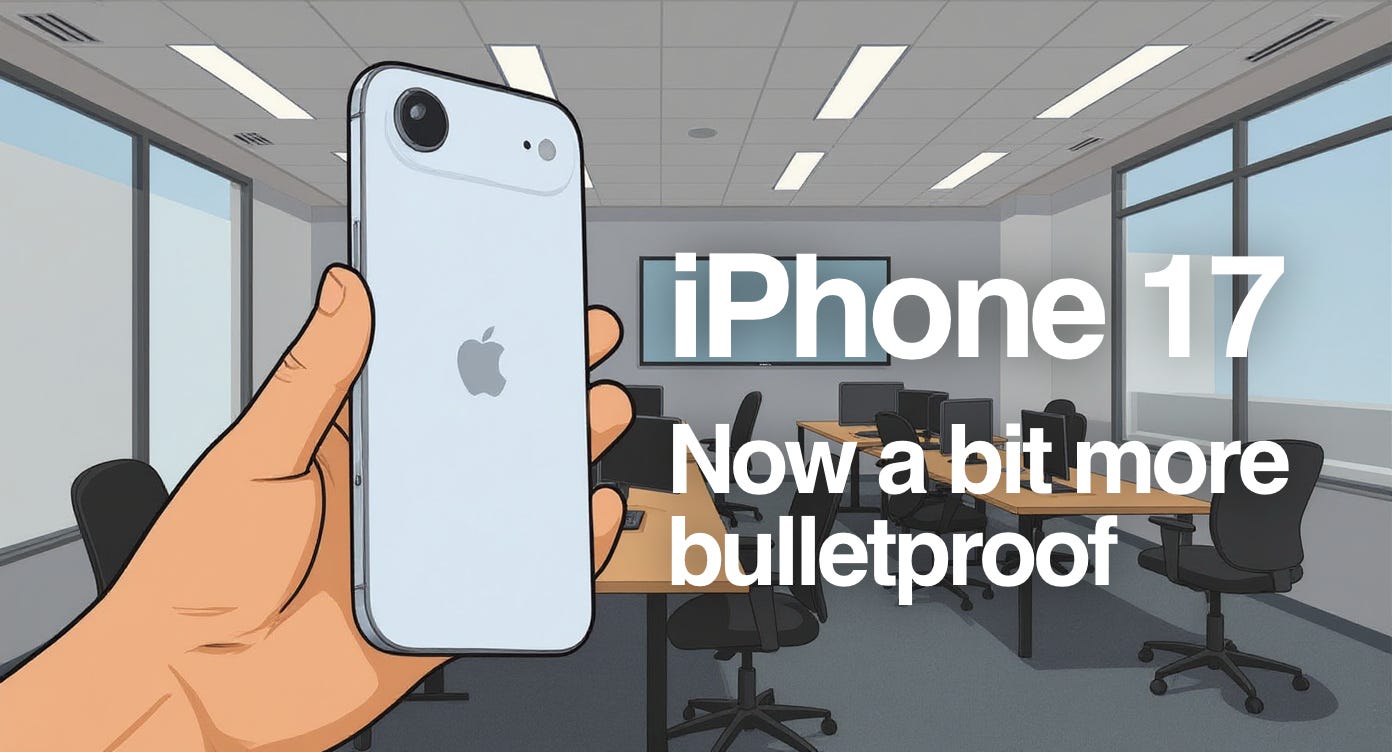
Just one WhatsApp message can destroy your business. iPhone 17 figured out how to stop it.

Most founders obsess over product-market fit, burn rate, and growth constraints. They build elaborate security protocols for their servers and databases. But they're missing the most obvious attack vector: the device sitting in their pocket.
Here's what I learned the hard way about how quickly everything can fall apart.
When one click nearly cost me everything
In 2019, I lost my iPhone. Not ideal timing—I was running a startup, had investors breathing down my neck, and my entire business lived in that little black rectangle.
I activated remote search but didn't enable immediate wiping. Big mistake. Within hours, I got an SMS that looked legitimate: "Access to your iCloud account has been restored. Link." or sorta, I do not remember now
The link looked real. The messaging felt authentic. I was stressed, distracted, and frankly desperate to get my phone back.
So I clicked. And entered my iPhone unlock code. “It was that moment he knew that he f***d up”. Really, just after the click I realized that I screwed up.
It was a sophisticated phishing operation targeting iCloud unlock services. These aren't random script kiddies—they're organized operations to unlock stolen phones, harvest the unlock credentials, and flip devices for profit. My desperation made me the perfect mark.
I managed to trigger remote wipe before they got deeper into my systems, but the damage assessment was brutal. Every password had to be changed. Every access point secured. Sensitive materials over Slack and e-mail must be reviewed for potential compromise.
That's when I understood a fundamental truth about modern business: your startup is only as secure as the weakest device in your founder's pocket.
The billion-dollar lesson from Jeff Bezos
If you think I'm being dramatic, consider what happened to the richest man in the world.
In May 2018, Jeff Bezos received a WhatsApp message from Saudi Crown Prince Mohammed bin Salman's account. It contained a video file. Bezos didn't click anything suspicious. He didn't download sketchy attachments. He simply received the message.
That was enough.
The video triggered a zero-click exploit—a sophisticated attack that requires no user interaction. Within hours, Bezos's phone transformed from a communication device into a surveillance tool. Data exfiltration jumped from 430KB daily to over 101MB. That's a 200x increase in outbound traffic.
The attackers used memory corruption vulnerabilities in video processing to gain complete device access. They installed persistent surveillance malware that operated invisibly for months. When forensic experts finally analyzed the device, they found attack chains so sophisticated they essentially created "a computer within a computer."
This wasn't some random hacker. This was nation-state level spyware—likely NSO Group's Pegasus—deployed against the CEO of Amazon.
The architecture of digital destruction
Here's the reality most founders don't understand: memory corruption vulnerabilities are the nuclear weapons of cyber warfare.
Every app that processes images, videos, or documents creates opportunities for buffer overflows, use-after-free exploits, and integer overflows. When attackers find these vulnerabilities, they can:
Execute arbitrary code without user interaction
Install persistent surveillance malware
Access encrypted communications and stored passwords
Exfiltrate sensitive business data
Use your device as a launching pad for deeper network attacks
The economics are brutal. Individual exploit chains cost millions to develop, but they target high-value individuals—executives, journalists, activists, and yes, startup founders (especially in crypto/web3) who might have valuable IP or investor connections.
Recent attacks show the evolution of this threat:
FORCEDENTRY (2021): Used iMessage's image processing to create a Turing-complete computing environment within a single exploit. Over 70,000 logical operations built a custom computer architecture inside the victim's phone.
PWNYOURHOME (2022-2023): Two-phase attack targeting HomeKit and iMessage, successfully bypassing Apple's Pointer Authentication Codes.
CVE-2025-43300: A zero-day in Apple's Image I/O framework that could trigger memory corruption through malicious image files—actively exploited against targeted individuals.
The common thread? Memory corruption vulnerabilities that turn everyday digital interactions into potential business catastrophes.
Why Apple's Memory Shield changes everything
Most security improvements are incremental—better encryption here, stronger authentication there. Memory Shield is different. It's architectural surgery.
Here's how it works: Every block of memory in iPhone 17 gets tagged with a secret code. When any process tries to access memory, the hardware checks if the request includes the correct tag. No match? The system immediately blocks access and terminates the process.
This isn't software trying to catch attacks after they start. This is hardware preventing entire classes of exploits from functioning at all.
Buffer overflows? Different memory regions get different tags, so spillover attacks hit a wall.
Use-after-free exploits? Memory gets retagged when reallocated, making old references instantly invalid.
Speculative execution attacks? Tag confidentiality protections prevent side-channel leakage.
Apple's offensive research team tested Memory Shield against six major exploit chains used in real attacks over the past three years. None could be rebuilt to bypass the new protections. Not adapted—rebuilt from scratch.
This breaks the economics of sophisticated attacks. Previously, attackers could swap similar memory corruption bugs when one got patched. Now they need completely new attack strategies, driving development costs through the roof while reducing reliability.
The hidden cost of founder devices
Here's what every startup should understand: when your founder's device gets compromised, it's not just personal data at risk.
Access to cloud infrastructure. Most founders have admin access to AWS, Google Cloud, or Azure through their phones. Device compromise = infrastructure compromise.
Business Email Compromises. Those WhatsApp threads with VCs or private equity? Telegram conversations about fundraising? Email chains about acquisition discussions? All visible to attackers, and might be a subject to extortion or spoofing.
Development resources. GitHub access, deployment pipelines, database credentials—much of this flows through founder devices.
Customer data. Support systems, CRM platforms, analytics dashboards (that means customer’s data) —accessible through mobile apps and saved passwords.
The startup failure statistics are sobering: 60% of companies close within six months of a serious cyberattack. For early-stage companies without extensive security infrastructure, a compromised founder device can be the single point of failure that kills the business.
The upgrade that's actually about necessity
For founders and C-level executives, iPhone 17 isn't an upgrade—it's business insurance.
Traditional security thinking focuses on perimeter defense: firewalls, VPNs, endpoint protection. But when the "endpoint" is the device that controls everything else, you need a different approach.
Memory Shield provides always-on, invisible protection that requires zero configuration. No security training needed. No complex policies to maintain. No performance impact on daily operations.
This is particularly crucial for technical founders who often resist "security theater" but understand real engineering solutions. Memory Shield isn't compliance checkbox—it's a fundamental shift in how devices handle potentially malicious code.
(And yes, the hardware is genuinely beautiful. Sometimes the best security solutions are also the most elegant ones.)
Building systems that survive contact with reality
The lesson extends beyond device security to startup architecture in general: build for the attacks you can't see coming.
Most founders optimize for known threats—competitors, market changes, funding gaps. But black swan events—sophisticated attacks, zero-day exploits, nation-state actors—can destroy companies overnight.
Memory Shield represents a philosophy I try to apply across all startup systems: defense in depth at the architectural level. Don't just patch vulnerabilities as they're discovered. Engineer solutions that eliminate entire categories of problems.
Whether it's device security, infrastructure design, or business processes, the startups that survive are the ones that prepare for threats they haven't imagined yet.
In an era where AI makes sophisticated attacks more accessible and geopolitical tensions increase cyber warfare, proactive security isn't paranoia—it's survival strategy.
The reality is simple: Apple just made it dramatically harder for one WhatsApp message to destroy your business. For founders, that might be the most valuable product feature released this decade.
What's the most overlooked security vulnerability in your company right now? The answer might be closer than you think.